How Dot works
Find them. Surround them. Move them.
Account-based advertising starts with a simple idea.
The organisations most valuable to your business are probably a relatively small part of the market.
Why plan your advertising as though everyone is equally valuable?
We organise the campaign around the companies, roles and commercial outcomes that matter.
Illustrative example: a software company targeting finance and IT buying groups at 60 selected businesses.
- 01Find them
Step 1
Choose the accounts
Companies, markets and the commercial objective.
60 mid-sized banks and insurers in South Africa and Kenya. Goal: get on the shortlist for a finance platform.
Output: Account plan
Step 2
Map the buying group
Relevant functions and seniority, then a check on reachable audience coverage.
CFOs and finance directors, CIOs and IT architects. Coverage checked market by market, with the gaps stated.
Output: Audience plan
- 02Surround them
Step 3
Match the message
Give each buying role a relevant reason to care.
Finance sees the cost case. IT sees integration and security.
Output: Creative plan
Step 4
Run the advertising
Display and native, with video where appropriate.
Display and native across the selected accounts, paced over the quarter.
Output: Live campaign
- 03Move them
Step 5
Read the signals
Delivery, engagement, website actions and available account-level reporting.
Which accounts and roles are engaging, and which pages they visit.
Output: Report
Step 6
Learn with sales
Combine the findings with account knowledge and refine the campaign.
Sales confirms which accounts are in conversation; budget moves towards them.
Output: Next action
Your wider marketing and sales
- CRM
- Sales outreach
- Content
- Events
Run by your team. Connected to Dot through planning at the start and feedback during the campaign.
What we run, and how we read it
Who runs what
Dot-managed media
- Programmatic displayCore
- Native advertisingCore
- Online videoWhere appropriate
Your wider marketing activity
- Sales outreach
- Events
- Content
- Search
Coordinated with Dot where appropriate. Run by your team or your other partners.
Account-level patterns
Illustrative dataWe read engagement by account and buying function, not by tracked individual.
| Account | Finance | IT | Procurement | Leadership |
|---|---|---|---|---|
| Account A | high | medium | low | medium |
| Account B | medium | high | none | low |
| Account C | low | low | medium | none |
| Account D | none | medium | none | low |
01 / Find them
Turn commercial knowledge into an audience.
You may already have a target-account list.
You may have an ideal customer profile and a clear idea of the organisations you want to reach.
Or you may need help defining the market.
We start there.
We examine company characteristics, buying roles, relevant markets and available data.
Then we assess how those audiences can be reached through appropriate advertising platforms.
The result is an audience architecture designed around your commercial objective.
02 / Surround them
Make familiarity work harder.
A single advertisement has a relatively small window in which to influence a complicated decision.
Repeated, relevant exposure creates more opportunities for your brand to become familiar.
Dot manages programmatic display and native advertising, with video available where appropriate.
Other channels can be coordinated with your existing marketing activity.
Messages can be structured around different buying roles and stages of consideration.
Your brand becomes more familiar to the people who matter.
03 / Move them
Attention needs somewhere to go.
An interested buyer may visit your website.
Read a piece of research.
Search for your company.
Register for an event.
Or simply become more familiar with your proposition.
We work with the available evidence to understand how relevant audience behaviour changes during a campaign.
That may include reach, frequency, engagement, website activity and subsequent commercial signals.
Sales outcomes remain important. Attribution depends on the data and measurement methods available.
Sample reports
Illustrative data
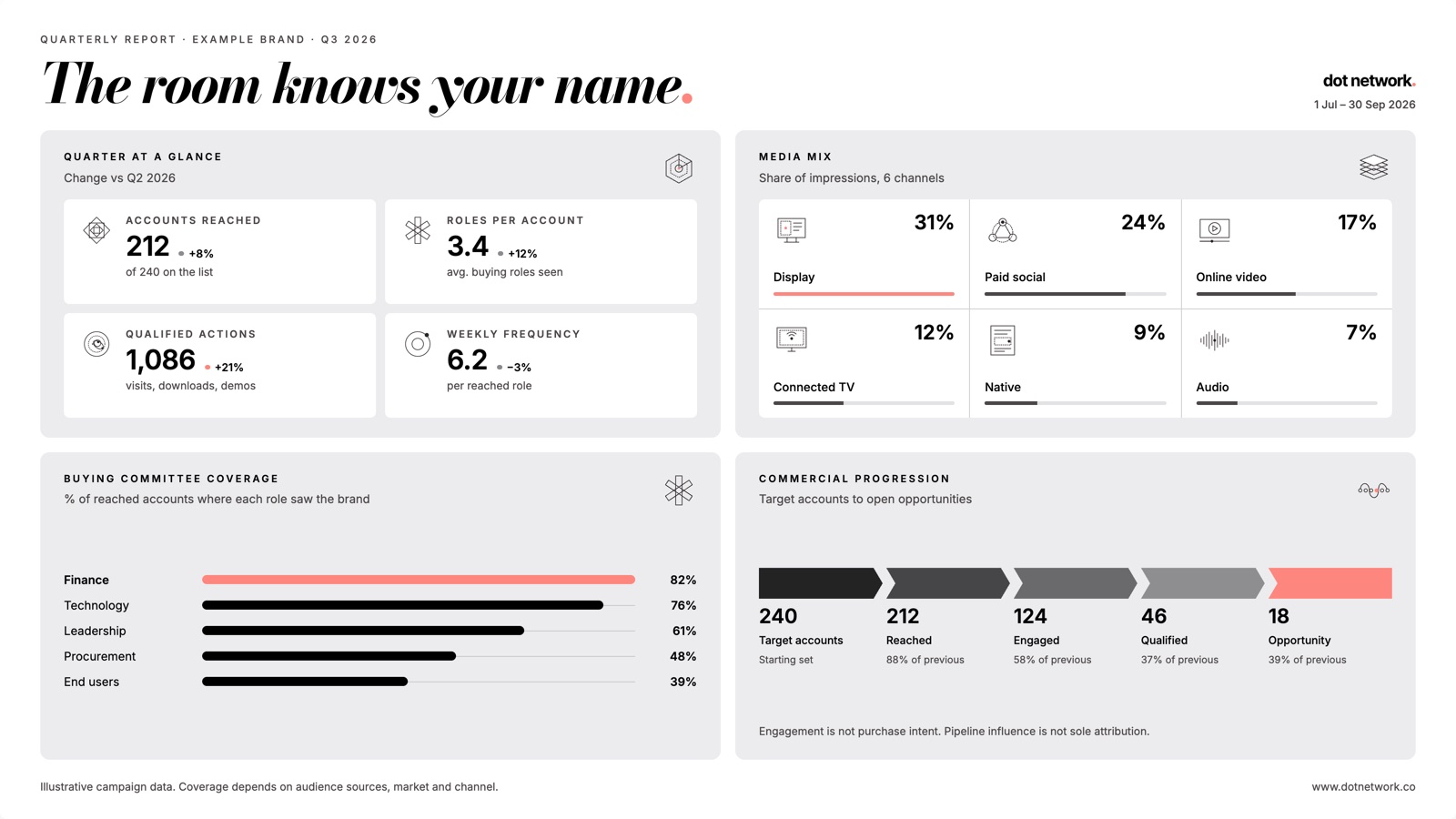
Examples, not client results. The budgets, channel mix and funnel numbers are illustrative. They are not a standard budget, a standard set of channels or a typical outcome. Your plan is set by your market and objective.
What depends on your data. Reach, frequency and media mix come from the advertising platforms. Website actions, account-level engagement and pipeline stages need your analytics and CRM connected, and attribution stays limited. Engagement is not purchase intent.
Getting started
You don't need to give us your customer database on day one.
01
Market snapshot
Tell us about the industry, geography, organisations and buying roles involved. We'll outline how we would approach the market.
02
Account Opportunity Map
Once there is an appropriate working relationship, we can examine a small sample of target accounts and assess the practical audience opportunities.
03
Campaign architecture
We agree the audience, channels, creative, measurement, costs and responsibilities.
04
Activation
The campaign begins with agreed objectives, reporting and optimisation.
Frequently asked questions.
What does a campaign cost?
Campaigns start from USD 10,000 a month, including media.
How long does it take to launch?
Usually two weeks from order, sometimes three, depending on the audience and the complexity of the creative.
Who does the work?
The Amorphous team. Dot Network is run by Amorphous New Media, a digital agency based in Johannesburg and Cape Town, which plans, runs and reports every Dot campaign.
Can you target specific companies?
We can build campaigns around named target accounts and relevant buying roles, subject to available data, platform capabilities and audience matching.
Reachability varies by market, channel and audience size.
Do we need a target-account list?
No.
We can begin with your ideal customer profile, target industries, relevant markets and buying roles.
A supplied target-account list allows us to develop a more specific account opportunity assessment once the appropriate data arrangements are in place.
How small can the audience be?
Small audiences are a specialist planning challenge.
The right size depends on the market, targeting methods, available inventory and campaign objective.
We assess audience feasibility before committing to a delivery plan.
Is this different from LinkedIn advertising?
LinkedIn can be a valuable channel for reaching professional audiences.
Dot builds account-based advertising programmes around the commercial audience first, then uses appropriate media channels to create relevant exposure.
That may extend across display, native, video and other coordinated activity.
Can you work with our existing creative?
Yes.
Supply your creative and we will resize it to the agreed advertising formats.
Or we can consult, concept and design the creative for you, subject to quote.
How do you measure success?
We begin by agreeing the commercial objective and available measurement methods.
Campaign reporting may include audience reach, frequency, engagement, relevant website behaviour and account-level activity where measurable.
We distinguish media delivery from commercial outcomes and explain the limits of attribution.
Do you work with agencies?
Yes.
Dot can work as a named specialist, integrated delivery partner, reseller or referral partner.
The operating model, responsibilities and commercials are agreed for each engagement.